

Türkiye has taken one of its most significant steps yet towards ending more than four decades of conflict with the Kurdistan Workers’ Party (PKK), after the Turkish Parliament overwhelmingly approved legislation offering thousands of its members a route back into civilian life if the organisation fully disarms.
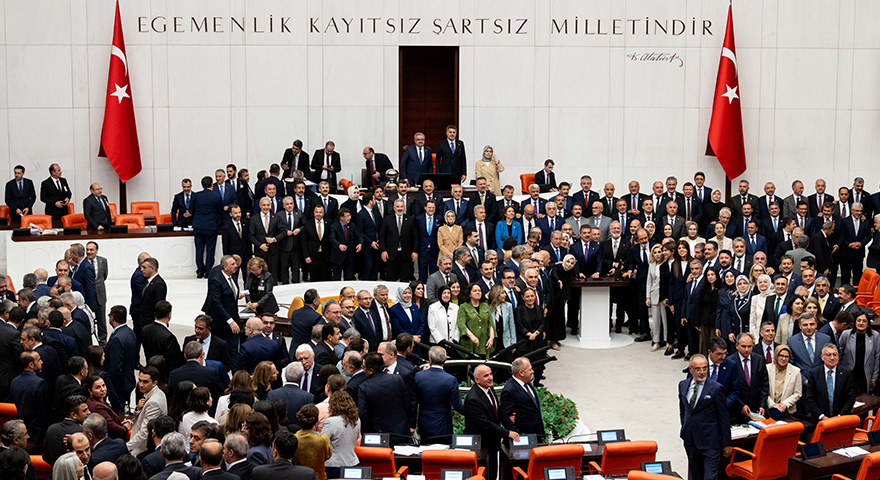
The Law on Strengthening National Solidarity and Social Integration was passed by the Turkish Grand National Assembly on 10 August by 468 votes to 88, with six abstentions, comfortably exceeding the two-thirds mark.
Although widely described as an “amnesty”, the 12-article legislation is more accurately a conditional pardon-like mechanism. It does not wipe convictions or offer an unconditional release to PKK members. Instead, investigations, prosecutions and prison sentences for eligible individuals can be suspended for periods of five or ten years, with cases eventually dropped or sentences regarded as served if they commit no further terrorism-related offences during that period.
Crucially, none of these provisions can be activated until Turkish security authorities determine that the PKK and associated structures have completely dissolved and surrendered their weapons and ammunition. That assessment must then be endorsed by Türkiye’s National Security Council and published in the Official Gazette. Eligible individuals will subsequently have six months to apply.
Rare political consensus behind peace law
One of the most striking features of the vote was its broad political support.
President Recep Tayyip Erdoğan’s ruling Justice and Development Party (AKP) backed the measure alongside its normally hardline nationalist ally, the Nationalist Movement Party (MHP). The main opposition Republican People’s Party (CHP) and the pro-Kurdish DEM Party also supported the legislation, as did most of parliament’s smaller parties, albeit with some individual dissent.
The principal organised opposition came from the nationalist İYİ (Good) Party, whose MPs argued that the measure amounted to an unacceptable amnesty and risked legitimising the PKK and its leadership. İYİ Party speakers repeatedly voiced their objections during the parliamentary debate.
The breadth of support is particularly remarkable given that it was MHP leader Devlet Bahçeli, one of Türkiye’s most uncompromising hard right politicians, who unexpectedly helped launch the current peace initiative in late 2024.
Bahçeli opened the door to engagement with imprisoned PKK leader Abdullah Öcalan, who in February 2025 issued a landmark appeal calling on the organisation he founded to lay down its weapons, dissolve itself and pursue its objectives through democratic politics instead. The PKK subsequently announced the end of its armed struggle and its dissolution, followed by a symbolic weapons-burning ceremony in northern Iraq.
A cross-party parliamentary commission established in August 2025 then spent months hearing politicians, officials and civil society representatives and drawing up proposals for how disarmament and reintegration could work in practice.
The new law is the first major legislative product of that process.
No amnesty for Öcalan or those convicted of killings
The legislation also draws an important line between PKK membership and serious violent crimes.
Those convicted of intentional killings carried out as part of the organisation’s activities are excluded, as are people convicted before 1 June 2005 of certain offences carrying life or aggravated life imprisonment.
That means Abdullah Öcalan is not being released under the new law.
Öcalan, who has been imprisoned on İmralı Island since 1999, remains outside its provisions, as do other senior PKK figures whose convictions fall within the exclusions. While Öcalan has become central to the peace process and may continue communicating with political representatives and the PKK during the transition, his future status will have to be dealt with separately.
For the government, this distinction is important: the legislation is intended to persuade people to abandon an armed organisation without granting impunity for killings.
Will the PKK actually meet the conditions?
There are grounds for cautious optimism, although the process is far from complete.
Unlike previous Turkish-Kurdish peace initiatives, the PKK has already formally declared an end to its armed struggle, announced its dissolution, begun withdrawing fighters and publicly destroyed weapons. Parliament has now provided something its members had repeatedly demanded: a legal mechanism explaining what happens to fighters once they disarm.
The unprecedented parliamentary majority behind the legislation is another significant advantage.
There are, however, substantial obstacles. The PKK has described the law as an important beginning but says it contains serious shortcomings, particularly the absence of provisions concerning Öcalan and wider democratic reforms. It has also argued that former fighters need reassurance they will be able to participate in lawful political activity without subsequently being prosecuted simply for their beliefs or associations.
It therefore remains to be seen how quickly the National Security Council will be satisfied that the organisation has genuinely and completely disarmed.
What does Türkiye’s Kurdish population gain?
For Türkiye’s millions of Kurdish citizens, the most immediate potential gain is also the most fundamental: an end to a conflict that has cost more than 40,000 lives, divided communities and inflicted a particularly heavy human and economic toll on the predominantly Kurdish southeast.
Families separated for years could see relatives return from PKK camps abroad, while a permanent end to armed conflict could bring greater security, investment and prosperity to areas that have borne much of the fighting. Residents of Diyarbakır interviewed by the Associated Press following the vote spoke of both relief and hopes for a more prosperous future.
Yet the new legislation does not itself grant broader Kurdish cultural or political rights.
Questions surrounding Kurdish-language rights, freedom of expression, Türkiye’s wide-ranging anti-terror legislation and the removal of elected Kurdish mayors remain unresolved. The Parliamentary Peace Commission has already recommended wider reforms, including stronger protections for free expression, changes to the treatment of non-violent offences under anti-terror laws and reforms to the controversial system whereby elected mayors can be replaced by government-appointed trustees.
For DEM Party politicians and many Kurdish civil society groups, therefore, the amnesty legislation is not the end of the Kurdish question but the beginning of a political phase in which grievances previously pursued through armed struggle should instead be addressed through democratic institutions.
That distinction may ultimately determine whether this process succeeds where earlier attempts failed.
After more than four decades of deaths, displacement and mistrust, Türkiye has created a credible legal route for guns to be permanently removed from the equation. The coming months will show whether the PKK completes its disarmament — and whether Ankara follows this historic security agreement with the democratic reforms needed to turn the absence of war into a lasting peace.
Main image, top, of the Turkish Grand National Assembly (TMBB) on 10 August at historic vote to pass the Law on Strengthening National Solidarity and Social Integration. Photo © TMBB.