Hundreds of people queued to enter Maraş, or Varosha in English, in the Turkish Republic of North Cyprus (TRNC) on Thursday, 8 October, to see part of the deserted seaside resort.
The historic moment came after the Turkish Cypriot Prime Minister Ersin Tatar, backed by Turkey, decided on Tuesday to partially open the ghost town to the public for the first time in 46 years.
Police guarded the barriers where civilians can now enter from the hours of 9am to 5pm, as workmen inside the fenced-off area hurriedly made final preparations for general access.
The opening was delayed by an hour, but at midday the assembled media and members of the public were finally allowed in to Varosha, where they made their way down a road called Demokrasi Street to the long stretch of beachfront now open to the public.
Dozens of derelict buildings lined the roads people strolled down. Gates, doors and window shutters hung awkwardly or were missing entirely, as nature took its course enveloping walls and gardens.
Tower blocks stood glaringly empty. There were parades of run-down shops, and the signs of well-known international brands such as Barclays Bank, Toyota and Hoover still clearly visible above their now vacant premises.
Red and white barricade tape stretched over large swathes of road, indicating that most buildings were strictly off-limits to the general public, possibly due to health and safety concerns.
One interesting discovery was that of the Bilal Ağa Foundation Mosque. Built by the Ottomans in 1813, this Islamic place of worship remains intact and its ownership reflects the property controversy that plagues much of Maraş.
According to Prof. Mustafa Haşim Altan, an expert in Turkish heritage and property in Cyprus, the mosque’s owners the Cyprus Islamic Foundation (Evkaf) was forced by the British colonial administration to sell the mosque in 1933 for 20 Lira to a private individual by the name of Haladajian of Varosha, who occupied the property for years without paying rent.
In 2019, the TRNC government launched a thorough audit of all property in Maraş, assessing their physical state and also examining ownership using official records.
The abandoned seaside resort has been under Turkish military control since the 1974 Cyprus War, when its mainly 39,000 Greek Cypriot inhabitants fled, and the island was divided into a Turkish North and Greek South.
Clip of the Bilal Ağa Foundation Mosque in Varosha, which was built by the Ottomans in 1813
A legally binding decision passed by the UN Security Council in 1984 bans the resettlement of non-Varosha residents in the town. UN Resolution 550 considers “attempts to settle any part of Varosha by people other than its inhabitants as inadmissible.” The resolution also calls for the entire area to be placed under the “administration of the United Nations”, which is firmly rejected by the Turkish side.
Yet the prospect of re-uniting Cyprus diminishes with each passing year. Five years ago Kudret Özersay, who has extensive experience of the Cyprus negotiations, suggested Maraş be opened to its lawful owners without waiting for a comprehensive settlement.
Dr Özersay took that further turning the idea into government policy when he became TRNC Foreign Minister two years ago. Conferences in Turkey and North Cyprus involving politicians, academics and lawyers have considered how Varosha can be re-opened while adhering to international law.
Public see state of derelict, run-down buildings in the abandoned town of Varosha/Maraş
Embed from Getty Images
In May and August of last year and again in February of this year, media and politicians from Turkey and the TRNC were given a tour of the deserted resort. The Turkish Cypriot government’s extensive inventory of the area is now complete and the Prime Minister has made no secret of the plans to re-open the town.
South Cyprus officials have regularly aired their concerns about Varosha to the international community. However, some refugees from the town have shown an interest in the opportunity to return to their homes and businesses, even if Varosha was under Turkish Cypriot control.
These refugees have been failed by a succession of Greek Cypriot leaders who promise much when first elected, but when given the opportunity, reject every internationally-backed peace plan presented to them – 11 in total between 1964 and 2017, when the last effort collapsed following major talks at Crans Montana in Switzerland.
TRNC PM Ersin Tatar leads the crowds into the newly opened Varosha/Maraş



 There is, however, another thorny legal issue: while the town’s buildings are mainly owned by Greek Cypriot, the vast majority of the land they sit on belongs to Evkaf.
In recent years the foundation, which has existed since 1571 and is protected under the Cyprus Constitution and other international treaties, has asserted its property rights more robustly in Varosha and across the rest of Cyprus, as old title deeds are matched with modern records, and the illegal transfer of their property under British colonial rule is challenged in the courts.
Evkaf head Prof. Benter claims that some 70% of the 2.3 square mile area that Varosha covers is the property of three Islamic trusts it administers: Lala Mustafa Paşa Vakfı, Mustafa Paşa, Abdullah Paşa, and Bilal Ağa. Unpicking these complex ownership issues between the inhabitants and Evkaf will no doubt require considerable time.
With this sensitive backdrop and the TRNC Presidential Election just days away, no one expected the announcement Prime Minister Ersin Tatar made on Tuesday evening.
There is, however, another thorny legal issue: while the town’s buildings are mainly owned by Greek Cypriot, the vast majority of the land they sit on belongs to Evkaf.
In recent years the foundation, which has existed since 1571 and is protected under the Cyprus Constitution and other international treaties, has asserted its property rights more robustly in Varosha and across the rest of Cyprus, as old title deeds are matched with modern records, and the illegal transfer of their property under British colonial rule is challenged in the courts.
Evkaf head Prof. Benter claims that some 70% of the 2.3 square mile area that Varosha covers is the property of three Islamic trusts it administers: Lala Mustafa Paşa Vakfı, Mustafa Paşa, Abdullah Paşa, and Bilal Ağa. Unpicking these complex ownership issues between the inhabitants and Evkaf will no doubt require considerable time.
With this sensitive backdrop and the TRNC Presidential Election just days away, no one expected the announcement Prime Minister Ersin Tatar made on Tuesday evening.
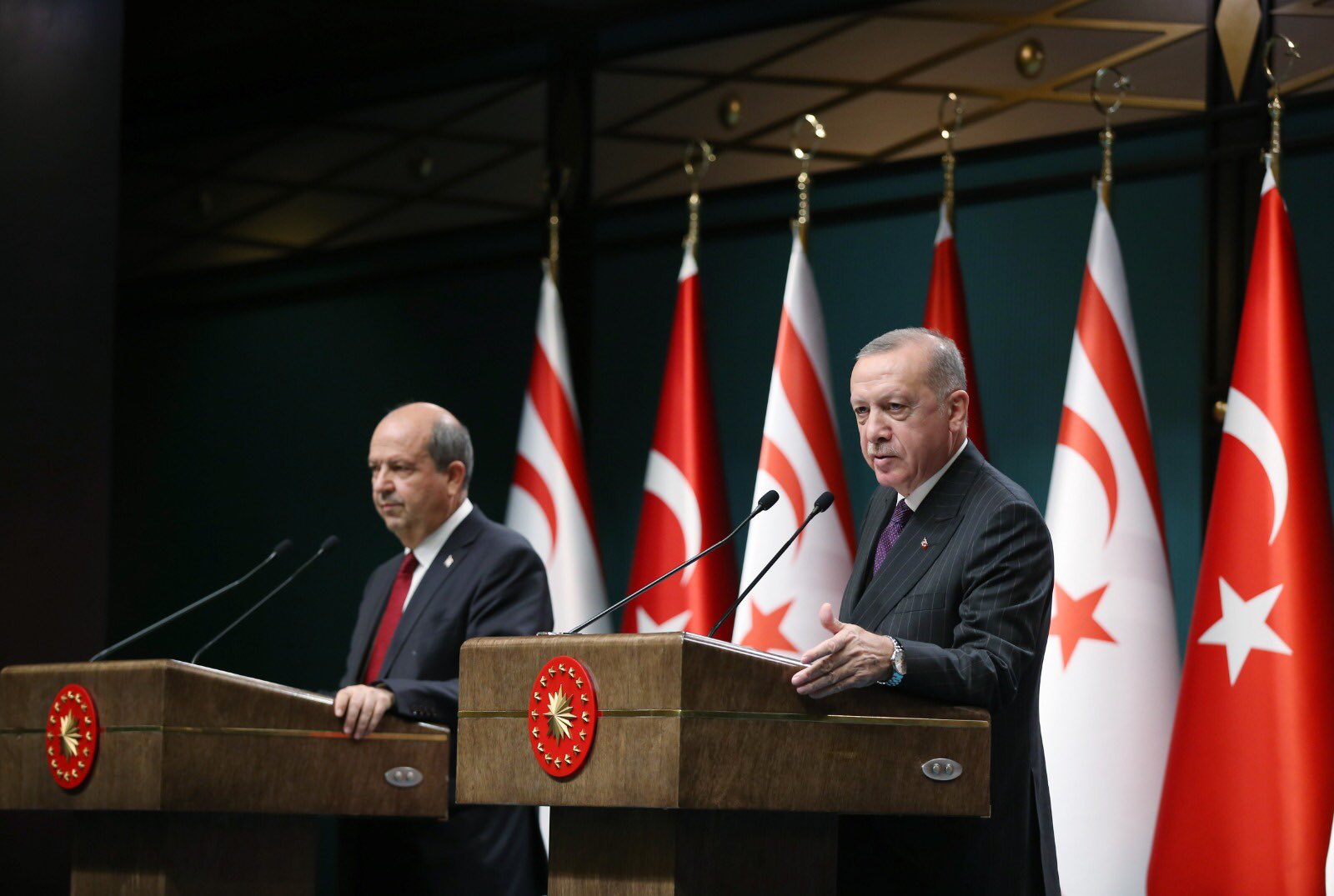
 TRNC PM Ersin Tatar and Turkish President Recep Tayyip Erdoğan hold a joint press conference in Ankara on 06 Oct. 2020. Photo © Twitter / T.C. Cumhurbaşkanlığı
 Relations between UBP and HP have been rocky for months. Here PM Ersin Tatar (right) sits with his coalition partner Kudret Özersay at the TRNC Parliament, 30 May 2019. Photo © TRNC PIO