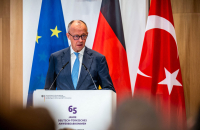


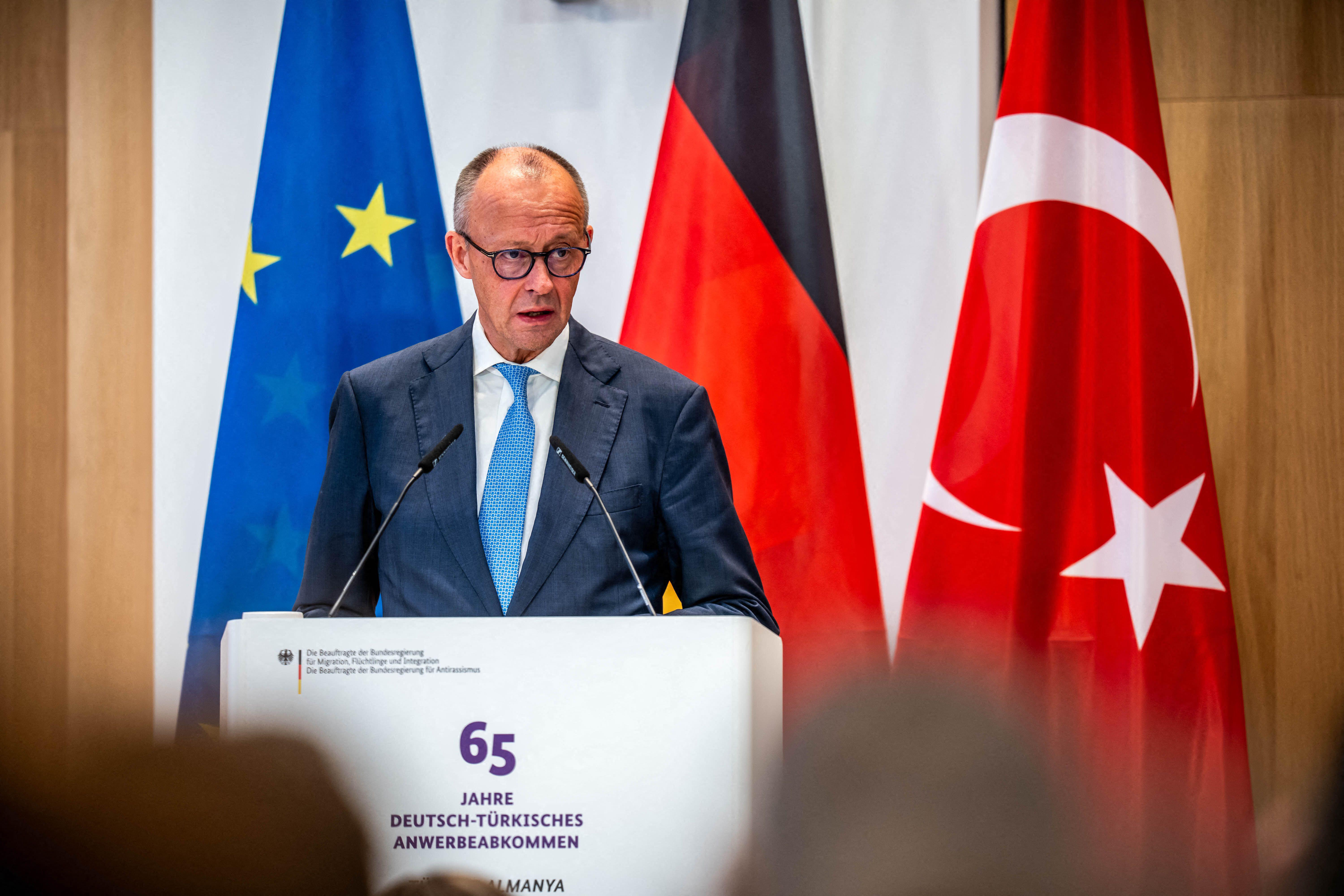
German Chancellor Friedrich Merz has praised the contribution of Turkish workers and their descendants to Germany’s prosperity, describing the migration that followed a landmark recruitment agreement 65 years ago as a success story.
Speaking at a ceremony in Berlin on Tuesday 20 October, Merz paid tribute to the generations who helped build the country’s industrial base and continue to shape its economy, science, culture and sport.
“Turkish guest workers helped build the industrial foundation of our country,” he said, according to Anadolu Agency.
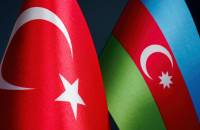
The ceremony was held ahead of the 65th anniversary of the agreement signed by West Germany and Türkiye on 30 October 1961, which recruited Turkish workers to meet labour shortages during Germany’s postwar economic boom.
Initially conceived as a temporary arrangement, it envisaged workers returning home after two years. That restriction was dropped in 1964, allowing longer stays and making it easier for families to join them.
Around 867,000 women and men travelled from Türkiye to West Germany under the programme before recruitment ended in 1973. Many worked in mines and factories, including in the Ruhr industrial region.
Although many returned to Türkiye, others settled permanently and raised families. Today, more than three million people in Germany have a Turkish migration background, according to the German government.
Merz highlighted the achievements of prominent figures with Turkish roots, including footballer İlkay Gündoğan, film director Fatih Akın, BioNTech founders Uğur Şahin and Özlem Türeci, and writers Aras Ören and Deniz Utlu.
Their successes, he said, were only the most visible examples of contributions made by thousands of people across Germany’s regions, professions, political parties, trade unions and employers’ organisations.
The Chancellor also acknowledged the discrimination experienced by Turkish families, with members of the first, second and even third generations still treated as outsiders despite their efforts to belong.
He recalled racist violence in Mölln and Solingen, the murders committed by the neo-Nazi National Socialist Underground (NSU), and the 2020 Hanau attack.
“Fear of the foreign is poison for every free society,” Merz warned.
He criticised the political use of the term “remigration”, describing it as an attack on the modern Germany that people of different backgrounds had built together over the past 65 years.
Merz presented integration as a shared responsibility, requiring effort both from newcomers and the wider society. While those arriving should respect democratic principles, including equality between women and men, they should also be able to expect equal opportunities and a sense of belonging.
He said Germany had become richer culturally, economically, scientifically and through its food thanks to migration from Türkiye, and stressed that the country continued to need skilled workers from abroad.
Also addressing the ceremony, Türkiye’s ambassador to Germany, Gökhan Turan, described the anniversary events as an expression of friendship between the two countries. Germany’s integration commissioner Natalie Pawlik warned of growing racism and the renewed exclusion of people from society.